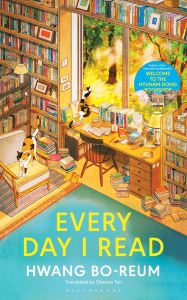
I got this nice small book by Hwang Bo-reum on December 25, and I read it all in one day. It was an easy book to read, and very enjoyable. The only small problem is that it took me longer than expected to read it because the author cites hundreds of books and I had to check many of them (and order many of them, too, and read information about their authors and all the books they wrote, and read book reviews, etc.). I went down many rabbit holes!!
Every chapter has a theme, like « Read On The Train » or « Don’t Just Read Classics, » etc. The chapters are short (2 to 5 pages long) and all start with a personal experience or thought, and then give some suggestions as to how and why these are good ideas, as well as some examples of books that the author read in those contexts.
It is not a deeply intellectual book. In fact, one thing I appreciated was that the author shares some of her « weaknesses, » like the fact that she sometimes reads very small books just so she can quickly add titles to her « books-I’ve-read list. » It is not a pretentious book, and many of the suggestions are quite simple to try. The books she mentions are sometimes long and complex, sometimes fun and easy, sometimes things I wanted to read, and sometimes things I don’t think I’d enjoy. Half of the books are by Korean and Japanese authors, and many, too, are by French and American authors, with some from Russian authors. There are authors from a few other countries, but I don’t remember any from Latin America, which is surprising, but the author is young and can’t be expected to have read everything from everywhere yet.
One thing the author does but I won’t do is to keep a notebook with quotes she likes from her readings. I think I did that for a while when I was young but I never found it really useful. Other than that, I found her comments and suggestions pretty reasonable and the book cute and interesting.
One thing Hwang says that touched me deeply was that she read a lot, all the time, every day, and forgot a lot of what she was reading. But, she says, even if she forgot it, it was all still inside her, and it made her who she was. And funnily enough, I was listening to an interview of Bonnefoy, the other day, and they played a clip of an interview with the architect Renzo Piano who said EXACTLY the same thing: we are what we read, who we met, what we did, what we saw, what we heard, even if we forgot most of it along the way, it’s what makes us us.


 Bouquins et musique
I forget many things, but I’m not as optimistic as the author. According to me, among Renzo Piano’s listing you quote, the most important item is « who we met » and I was lucky to meet you even if it wasn’t in real life.
J’aimeJ’aime
I agree with you, who we met is probably what has the biggest impact on who we are 🙂 I also feel lucky that you and I met 🙂
J’aimeJ’aime
Evidemment que ce livre n’existe à la bibliothèque 🤬. Je ne vais pas utiliser un crédit audio (j’ai repris mon abo pour écouter le livre que tu recommandais sur la créativité). Je le télécharge ? Je sais que c’est mal.
J’aimeJ’aime
Ca n’en vaut pas la peine, je pense que ta bibliothèque l’aura dans quelques mois.
J’aimeJ’aime