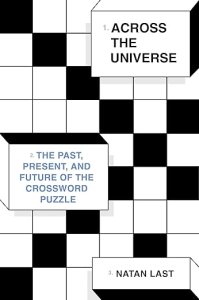
Across the Universe–The Past, Present, and Future of the Crossword Puzzle, by Natan Last, was one tough book to read! It felt like I was reading a dictionary sometimes! It was dense, the language was highly sophisticated, and the information was packed tightly! But it was also extremely interesting and sometimes even funny 🙂
I am not a fan of crossword puzzles, but I do word games like the New York Times’ Wordle, Connections, and « The Mini » every morning. I am definitely a fan of words and language in general, so I did enjoy this book, especially the parts that talked about the evolution of the type of language used in crosswords over the years. For example, some people were very famous at a certain time in history but were completely forgotten after a while, so they never showed up again in puzzles. Some concepts evolved and history changed, so the same famous African « terrorist group » name that was used in puzzles in early 20th century was then described as a « militant group » by mid-century, and then a few decades later, the same group was called a « resistance fighter group » and finally, they became « members of a liberation movement » in the clues.
What I also enjoyed a lot was the discussion about the purpose of these crossword puzzles. Some people saw them as a waste of time or even dangerous games that might destroy your brain, some people said they were meant to teach something (new words, new definitions, new names) to the player, others thought they should be apolitical while others thought they should represent current events, and others yet thought they should remind players of how smart they are and not make them feel incompetent or uneducated. Different historical times (during a war, after a war, during COVID, etc.) also saw crossword puzzles become less or more popular, with fewer or more people creating them and enjoying solving them.
The book also talks about another fascinating aspect of language: culture, and how certain definitions and words are neutral or had certain connotations that were « bad » or « unpopular » at a certain time in history. All types of discrimination can be found in the words and the clues of crossword puzzles across history (and countries and places, too). For example, some crossword puzzle editors were very liberal, others were strongly politically engaged in certain movements (like the recognition of LGBTQ+), some only accepted crossword puzzles written by men, while others encouraged a very diverse crowd of puzzle creators to submit their puzzles, etc.
One thing I had not realized at all was how different crossword puzzles could be in different countries. Every country has their own rules for grids, words that can be used or not, clues and definitions, design, themes, etc. For example, the grids of American crossword puzzles have always been symmetrical, while French puzzles are not (the black squares can be anywhere); all the letters in American puzzles are used twice (by a down word and an across word) but that’s not the case with British puzzles. Etc.
Super interesting.


 Bouquins et musique
This summary is very interesting. As a former math teacher, I notice this sentence which puzzles me: « the grids of American crossword puzzles have always been symmetrical, while French puzzles are not ». Rather than to the country, the symmetry can also be linked to the language the clues are written in. Have a look at today’s New Zealand grid whose clues are written in English.:
https://grownups.co.nz/games/crossword/This grid is perfectly symmetrical, isn’t it?
Canada is a good country to answer that question. Do Canadian crossword puzzles whose clues are written in French look like French puzzles? Thank you for your answer.
J’aimeJ’aime
Very true, mmechapeau, thank you for this question. You are right, Canadian francophone puzzles look like French puzzles and Canadian anglophone puzzles look like the American ones, so the design could depend on the language. I haven’t checked other anglophone and francophone countries though, and I think that British puzzles are not like American puzzles, so the language rule doesn’t seem to apply everywhere.
J’aimeJ’aime
Here, we are told there are some differences between American-style and British-style, but both puzzles have symmetrical grids.
https://alwayspuzzling.blogspot.com/2013/01/american-vs-british-crosswords.html
Yesterday, I found this Australian grid which was symmetrical too.
https://www.thenewdaily.com.au/puzzles/quiz-crossword
J’aimeJ’aime
Well, a new book on crossword puzzles should definitely be written, about the differences and similarities in different countries and languages 🙂
J’aimeJ’aime
Actually, the Universe of the Crossword Puzzle looks a bit like the one of Sign Languages we spoke about with our friend Bleck some days ago. Everyone thinks both of them are universal but they aren’t.
J’aimeJ’aime
Very true 🙂 Although I bet more people think crossword puzzles are universal than Sign Language! I hope.
J’aimeJ’aime
If Sign Language had been universal, it could have been a good substitute for Esperanto 🙂.
J’aimeJ’aime