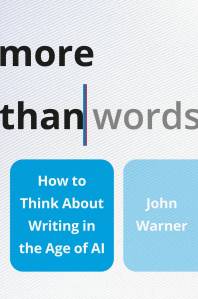
« You are going to spend your whole life learning how to write… and then you are going to die » (Jeff O’Neal, as cited by John Warner).
This is a wonderful book, and I recommend it to anyone interested in writing, teaching, thinking, feeling, and living! And artificial intelligence, of course. This is a book I wish every university student would read! And everyone in general, too.
This book is the FIRST one on AI and writing that actually moved me. Honestly. I almost wanted to cry at the beginning, when Warner was talking about the meaning and purpose of writing, and the place of writing in the world. I am not emotional about many things, but wow, that book made me FEEL the importance of thinking and writing and living a life beyond Large Language Models, beyond Amazon and Netflix, beyond ChatGPT’s amazing performances, beyond the internet, beyond social media.
One thing that is emphasized in this book and that I heard in a recent conference I attended (Women in AI Ethics) is the idea of individuality. One of the presenters at the conference explained that every big societal change (planes, women voting, Civil Rights, the Space Race, etc.) was brought on by people who were different than « the rest, » people who saw the world differently, who thought different thoughts, who envisioned the possibility of a different world. None of these historical changes, inventions, and movements would have been possible if everyone had been learning and thinking the same things! Yet today, we all have a tendency to watch what Netflix suggests we watch, go where Google suggests we go, buy what Amazon or some influencers or our FB friends suggest we buy, and write what LLMs suggest we write. We are all starting to think and learn and know the same things!
Another thing that is emphasized in this book is the real meaning of WRITING. Warner explains (much better than I can) that writing is about memories and experiences, our thoughts and lives, our observations and reflections, our growth, our knowledge and expertise, our understanding of the world, and our desire to record or share all this with others, while ChatGPT’s « output » (I will never call it « writing » anymore) is about a statistical probability that a word appears after another. There is no thinking (yet), no emotion, no past experience, no memories, no reflection, no learning, no expertise, no knowledge, no desire, no understanding of anything except the algorithm.
It is rare that a book is able to change my understanding of my job so strongly.
(And yes, I will still ask ChatGPT to tell me if there are typos or errors in this text, but it is otherwise 100% written by me, a human being (although also a cog in the machine), as were all the previous posts on this blog and my old blog.)


Thank you for this enthusiastic post. Sharing these considerations with us Neanderthal people ( I mean « avec nous les Béotiens » but I’m not sure of the chosen traduction* ) is a good idea and your text explains the issue very well.
[ * I could have asked ChatGPT to help me, but I haven’t taken that kind of plunge yet 🙂. ]
J’aimeJ’aime
Huhuh, I love the Neanderthal people, beautiful 🙂 But you are not THAT old or ignorant, don’t worry. You know many things that I don’t know, you just don’t write them on a blog. (Don’t take the ChatGPT plunge, it’s not worth it, once you get used to it it’s very addictive!)
J’aimeJ’aime
C’est intéressant que tu dises de ne pas plonger dans ChatGPT. J’ai une amie qui a demandé à l’IA de me préparer ma lettre de motivation pour un job et je l’ai trouvée pas mal, ce qui ne m’a pas empêchée de toute la retravailler. Mais les idées étaient bien et je me suis demandé si je ne passais pas à côté de quelque chose en m’obstinant à ne pas utiliser ce truc.
J’aimeJ’aime