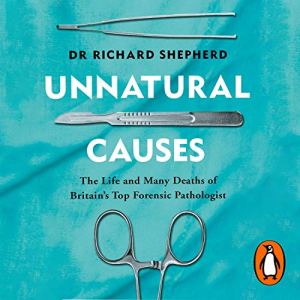
This book was really, really interesting! It tells the story (narrated by the author himself) of the life of a forensic pathologist in the UK—his childhood, how he became a forensic pathologist, his first few years on the job, the famous and less famous cases he worked on, infanticide, how things unfold during a trial, murder, decomposition, accidents, SIDS, a complicated family life, terrorism, professional rivalries, sad cases, significant changes in criminal laws and their reasons, complications, changes in society, and everything in between.
It’s told with just enough arrogance to remind the listener that this is the man who performed one of the post-mortems on Princess Diana, but who was also kind enough to help uncomfortable police officers and detectives through the different (and often gruesome) steps of a post-mortem. I learned tons of fascinating things, yet the writing was simple, direct, free of complicated medical jargon or emotion, and welcoming—in a “just in case you’ve ever had questions about this” kind of way. In fact, he explains everything quite clearly and offers some interesting details about many well-known and lesser-known cases and their impact on the work of forensic pathologists, police officers, lawyers, etc. It was never horrifying or disgusting. Sometimes it was very descriptive and sad, like in the chapters about infanticide, but he approached it with great respect. He mixed stories from his personal life with those from his professional life, especially at the end, which some reviewers found annoying, but I think our personal and professional lives influence each other, and they often explain one another. And I think it was courageous of him to talk about his weaknesses, fears, and challenges.
The one thing that I wish he’d done differently (although maybe it would have made things worse) is that he talked about things chronologically. Since « justice » is never a quick process, he would talk about case A once, and then case B, and then years later, after cases L, M, and N, case A would be appealed and he would talk about case A again, and then maybe about case C, because DNA testing had appeared and some old cases were reopened, etc. Since I have a bad memory, it was difficult for me to remember who had done what and when years earlier. I understand why he did that, because societal and technological changes had an impact on his job, like the perception of infanticide, or women and self-defence, or the closure of forensic medical schools, for example. But it just made some stories a bit difficult to follow. Part of the problem, too, is that the most famous cases he discussed were very well known in the UK, so British readers could remember them easily, but as a French-Swiss-Canadian reader, I only knew of Princess Diana and 9/11 and the Paris attacks of 2015, not much else. If you want to read this book, I strongly recommend you learn about the murder of Stephen Lawrence, the Marchioness disaster, and also Sally Clark‘s case, because they come up several times.
Overall, an incredible book.


 Bouquins et musique
Do you know we also have a forensic pathologist who writes books. His name is Philippe Boxho and you can hear about him on Wikipedia https://fr.wikipedia.org/wiki/Philippe_Boxho
J’aimeJ’aime
I didn’t know him, sounds interesting, too! I think what’s maybe a bit different about Unnatural Causes is that he talks about his life, it’s a whole story, not individual chapters with individual stories. He talks about how society and the laws changed, how the job changed, etc. Also, I think he changes things (names, contexts, etc.) a bit more than the author of Unnatural Causes. But I haven’t read Boxho’s book (just watched a quick interview), so maybe I’m wrong.
J’aimeJ’aime
I can’t help you. So far, I have read neither the book you spoke about, nor any book by Philippe Boxho.
J’aimeJ’aime
Maybe you should 🙂
J’aimeJ’aime