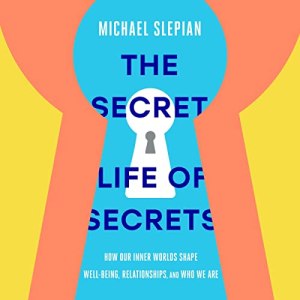
This was an interesting book to listen to. Michael Slepian talks about several studies done on the psychology of secrets, why we keep secrets, when, how, the effects on our mental and physical health, and the fact that we all keep secrets, sometimes small ones, but we all do! He also talks about children and how/when they learn to lie and keep secrets–that was particularly interesting.
He also talks about positive and negative secrets, and how the purpose of secrets will make them easier or harder to keep. He explains the difference between sharing a secret (i.e., spilling the beans) and confiding in someone, and how that can help us feel less burdened by the secret. Also, the stress of keeping a secret is less harmful to us than the rumination we can do about it!
What made me laugh was that at the beginning, I thought « oh, I don’t really have that many secrets, » but when the author enumerated a list of the 40 most common secrets, I realized how many secrets I am actually keeping without realizing it (I shared some there)! I also enjoyed learning about secrets across different cultures, big cities versus isolated areas, etc. I found that part of the book the most interesting one.
It was not the best book I ever read, but it was interesting and easy to listen to, and I did learn a few things (about the world, people, and myself).


 Bouquins et musique
This kind of research sounds funnier than the one about phonology you have had to conduct in one of your former lives ( cf. who’s cheating who? ). According to what we were told, next year, you would like to attend some law class. Aren’t you afraid of a law program being humorless too?
J’aimeJ’aime
Humourless doesn’t mean not interesting 🙂 Psychology research is fascinating but it’s impossible to know how to get the truth out of human beings when human beings are so complex and they don’t even know what the truth about themselves is. Phonetics and phonology (which were only a small part of my previous life, as I was a sociolinguist) are easier to study, as a sound is a sound, not a belief or an emotion or an attitude. The law is definitely « dry » but so complex that it almost becomes a mystery you must solve. I’d say that on a continuum from soft science (psychology) to hard science (math), phonetics/phonology is on the side of math and law is kind of in the middle 🙂
J’aimeJ’aime
Thank you for this new answer. If you are allowed to study law next year, I wish you a lot of happiness when doing it ⚖️.
J’aimeJ’aime
Thank you 🙂 I don’t expect much happiness to come from that course, but I do expect to be surprised, shocked, and amazed many times 🙂
J’aimeJ’aime