What I liked about this book:
- It was not just about the US.
- It was absolutely fascinating, shocking, and very eye-opening about our « western » societies.
What I disliked about this book:
- It was at times very philosophical and abstract, and it did not always provide enough concrete examples.
- It took me a huge amount of time to read because I had to learn more about every fact mentioned in the book!
Thoughts:
- This book makes me realize how incredibly lucky I am to have the rights and freedoms and opportunities I got. Everything in our lives, good and bad, is a result of what citizenships(s) we have!
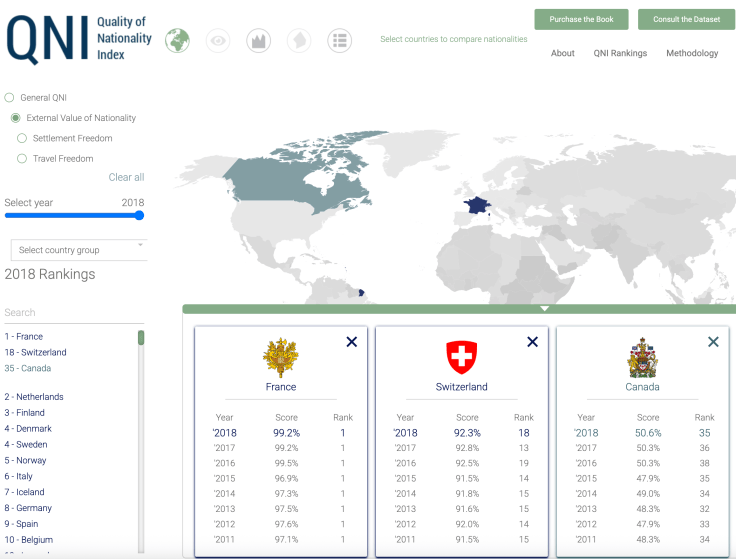
- Something I never thought about before: as a French citizen living in Canada, I enjoy all of the rights of the French citizens but none of the duties of the French residents. I don’t pay taxes in France today, but I could still return tomorrow and immediately enjoy rights that a non-citizen would spend years trying to acquire. As a French citizen abroad, I possess:
- A guaranteed right of return.
- Access to one of the world’s wealthier democracies.
- The right to vote in French presidential, parliamentary, European, and other elections.
- The right to run for public office.
- The right to enter, live, and work in France without ANY restrictions.
- The right to consular protection from the French state anywhere in the world.
- The right to live and work throughout the European Union under EU free-movement rules.
- Citizenship is not based on identity: two 50-year old universities professors, smart, women, with no kids, not married, and living in Canada, do not necessarily have the same citizenship. The opposite is true, too: an LGBTQ+ woman of colour, single, with no kids, university professor, and living in Germany, can have the Canadian citizenship just as much as a a white supremacist man, farmer, married, with five kids, living in the US.
- Citizenship is also not about values (although it’s often claimed it is), since a murderous Norwegian still enjoys the same rights and opportunities as « good » Norwegians, while a virtuous and smart Pakistani woman will not be welcomed anywhere in the world or treated fairly, even in her own country. This also creates situations where a Dutch sociopath can vote, but not a non-citizen who was born in The Netherlands and has been living a good and honest life there. And the sociopath will probably vote on laws that will affect the non-citizen a lot more than they will affect him.
Exemples:
- A child born in American Samoa will not be a U.S. citizen, acquiring a U.S. “non-citizen national” status instead, although American Samoa is a territory fully under the sovereignty of the United States.
- One out of five Swiss citizens has two nationalities or more.
- A child born from two Colombian parents in a country where children are NOT automatically given citizenship if they are born there (e.g., France) has no citizenship!
- In 2017, Cambodia took away the citizenship of more than 100,000 people from minority ethnicities, saying that these people’s ancestors had originally come « from somewhere else. »
- The splitting up of Czechoslovakia and Yugoslavia produced several new citizenships, with some newly created countries (such as the Czech Republic) taking the exercise of defining « who we are as a nation » as an opportunity to get rid of minorities like the Roma.
- According to UNHCR, there are roughly ten million stateless people around the world today.
- Not all EU countries are in the Schengen agreement (Cyprus and Ireland) and not all Schengen countries are in the EU (e.g., Iceland).


Thank you for this review filled with interesting examples. The concept of citizenship is too serious a topic to be commented any which way as I’m accustomed to doing. I was born as a Begian citizen by chance and I’m used to thanking my lucky star for it.
J’aimeJ’aime
It is indeed a serious topic, but when I was growing up in Switzerland, we (the Swiss) had many jokes about the people of Belgium. To be fair, the French often made jokes about the people of Switzerland. Do you have jokes about people from other countries in Belgium? I hope you make fun of the French 😉 That way, it’s full circle!
J’aimeJ’aime
I’m awfully sorry but I’m not a joke teller and the people I rub shoulders with don’t belong to this variety either. About Switzerland, there is the famous joke about the letters CFF SBB one could read on Swiss trains last century. If you don’t know it, I can tell it to you.
J’aimeJ’aime
What do you mean, « last century »? Can’t you still see these letters? SBB CFF FFS? Anyway, I know the joke 🙂
J’aimeJ’aime
Unlike you, I hardly ever travel. The last time I saw Swiss trains was last century…
J’aimeJ’aime
Are you aware? Yesterday, a Swiss cyclist, Mauro Schmid won the longest stage of the Tour de France 2026. The racing cyclists went from Dole to Belfort and of course, they had to climb up and down the Ballon d’Alsace before reaching Belfort.
J’aimeJ’aime
I didn’t even know that the Tour de France was on. With these high temperatures, it must be hard for the cyclists! And it’d be fun to have a Swiss winner 🙂
J’aimeJ’aime
You are right. This Tour de France is awfully hard for the cyclists. Adjustments were asked by the riders and their unions but they were told those adjustments would take place in the coming years…
J’aimeJ’aime
One of my friends has just passed his British citizenship test so I might buy this for him! I keep reminding him that he still needs to work on becoming more British e.g. saying “Mustn’t grumble” when his life is falling apart, or “Gentle reminder” when someone has made him absolutely furious.
J’aimeJ’aime
Congrats to your friend! I took the Swiss exams (there were two!) and the Canadian exam, and these things (including the paperwork) are not easy! Adopting the local culture can take years, too. I’m glad you’re helping your friend 😆
J’aimeAimé par 1 personne