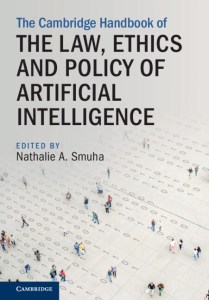
I started reading this handbook in December and read the first third during the Christmas break. I read the second third in February/March, while waiting for my new foot brace to be modified over and over and over. And I finally managed to finish the darn thing during the last week of May, after university classes were over.
Here were the chapters:
- Introduction to Law, Ethics, and Policy of Artificial Intelligence
- Artificial Intelligence
- Philosophy of AI
- Ethics of AI
- Fairness and AI
- Moral Responsibility and Autonomous Technologies
- AI, Power and Sustainability
- AI Meets the GDPR
- Tort Liability and AI
- AI and Competition Law
- AI and Consumer Protection
- AI and Intellectual Property Law
- The European Union’s AI Act
- AI and Education
- AI and Media
- AI and Healthcare Data
- AI and Financial Services
- AI and Labor Law
- Legal, Ethical, and Societal Issues and Law Enforcement
- The Use of Algorithmic Systems by Public Administrations
- AI and Armed Conflicts
- Conclusion
Holy cannelloni, that was not a short and easy book to read, but it was super super SUPER interesting! My favourite chapters were 4, 7, 8, and from 11 to 21. Very few people really understand all the areas where artificial intelligence is taking a huge place now, and how it affects them on a daily basis without them realizing it. It’s tragic! The information in chapters 11, 16, 17, 19, and 20, in particular, shows that AI affects EVERYONE, ALL THE TIME! What we eat, what we buy, what we read and watch and listen to, what we can and can’t do, our safety, our laws, EVERYTHING*!
You watch Netflix? You buy a book online? You use a GPS? You wear a smartwatch? You order food delivery? You rent an apartment? You watch the news on TV? You visit your doctor? You buy medication? You use a credit card? You do a search on Google? You drive on a highway? You have an email address? You have insurance? You scroll through social media? You book a hotel? You buy a new car? You get on a plane? You have money in the bank? You’re looking for a job? You take an Uber? You cross a border? You renew your identity card? You vote? You get a salary? You have kids? You use a loyalty/points card at the store? You are retired? You have a cell phone? And on and on and on. All these and a thousand more areas of your life have been affected, mediated, regulated, and transformed by artificial intelligence for a while and are now SIGNIFICANTLY more and more so every day.
What was particularly interesting for me, about this book, was that it focused on the European context, not on « the North, » as the US/Canada context is called (often in a military context). I was particularly glad to learn about the GDPR and EU AI Act, for example, because it’ll help me compare with what’s happening in « the North » when I take my law classes in the fall/winter.
I am so excited! And so scared. Excited and scared of law school, and just plain scared of the future.
* Another book I’m currently reading explains the « AI drift » as the fact that when we get used to a new way to use AI (for example to analyze bank loan applications, which has now been done for about 10 years), we stop thinking it is AI (and therefore potentially harmful) and just accept it as « basic technology. »


Thank you for this new review. Firstly, I do hope the trouble with your foot brace is now behind you. Then, I hope you’ll enjoy both your job as an aunt and the one as a law student. As to the future, I’m also scared, « à donf » as some people are accustomed to saying on this side of the pond. Concerning the topic we are told about, you sound as if you were already a good expert. Therefore, according to me, you don’t have to feel scared of law school. It looks as if a friend of yours, the one « Impostor Syndrome » is back. [ I’m teasing you 🙂 ]
J’aimeJ’aime
You are perfectly right, my friend is back! I know that I know stuff about AI in general, but I don’t know a lot of detailed information about the law. For example, I know only a little bit about intellectual property, I have read a couple of things about it in this book and others, but I will take a whole course on Intellectual Property now, so it’s going to be much, much more detailed information!
J’aimeJ’aime
It takes courage to begin such studies, but you’ll get there. I believe in you 🙂.
J’aimeJ’aime
Thank you 🙂
J’aimeJ’aime
Oui, c’est sûr qu’il y a de l’IA dans des tas de trucs et qu’on n’y pense même plus. Quand j’appelle mon assurance et qu’une voix me demande d’articuler clairement le motif de mon appel, c’est de l’intelligence artificicielle; et ça fait au moins 15 ans que c’est comme ça… La banalisation nous guette.
J’aimeJ’aime
Eh oui, the AI drift, comme dit le gars, on n’y pense même plus, et pourtant, on devrait!!
J’aimeJ’aime