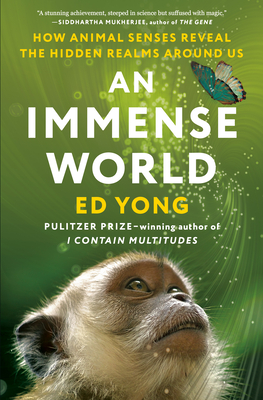
This book was very detailed, very fascinating, and very long. It was more readily interesting than No Stone Unturned, more exciting than Book and Dagger, and a lot easier to understand than The Code Breaker, but these four books are of similar length and they all describe something extremely important in extensive detail.
In his book, Yong talks about the senses of smell and taste, light and colour, pain, heat, the sense of touch, vibrations and pulses, sounds, echolocation, electrolocation and electrocommunication, magnetic fields, and many other ways that animals use their senses to move, hunt, eat, hide, communicate, protect themselves, and adapt to changing environments in the modern world. Yong meets with biologists of all kinds, all over the world, and shares the latest, most incredible discoveries about nature and everything that surrounds us. He explains that we are unaware of 95% of what’s really happening around us, the smells, the noises, the vibrations, the colours, the electric fields, and how humans always thought they were smarter than animals, but in reality, animals have skills that no humans can possess or even imagine!
The book’s overall theme is the notion of umwelt, the specific way in which individual organisms (including human beings) perceive and experience the world, shaped by the capabilities of their sensory organs and perceptual systems. He explains that every species has its own umwelt; but he also explains that even individual human beings possess individual umwelten, since I will never be able to see colours or hear sounds or feel pain in exactly the same way as someone else, so the way I perceive and experience the world is unique. What makes human beings different from other animals is that we can talk about our experiences and perceptions, and try to describe and compare things (« I see this colour as more green than blue, » for example), whereas animals can’t tell us much. Scientists can study animals, but sometimes, that’s nearly impossible, and many things remain mysterious, like the migratory birds’ « organ » that senses the earth’s magnetic field, or how flowers can modify their electric field to attract bees, or how some animals can compensate for the Doppler effect when trying to communicate and getting closer to or farther from one another. It’s also difficult to study animals because humans use their own umwelt to imagine what animals can do, but it’s really difficult to imagine things that we don’t even know can exist.
What I particularly enjoyed was to learn how science has evolved since I learned about biology as a child. For example, we learned that spiders are moved around by airflow and wind gusts, but it now seems like they are propulsed by the Earth’s atmospheric electric field, as spider silk becomes electrically charged as it leaves the spinnerets, and the repulsive force between charged strands and the interaction with the atmospheric electric field can lift the spider. We also learn about the ways our modern world changes (e.g., more lights, more noises, more construction) and how that affects myriad animals negatively.
A long but really fascinating book!


Thank you for your explanations. This book by Ed Yong sounds effectively fascinating. I guess you made a lot of discoveries when reading it. But wasn’t it too difficult to understand?
J’aimeJ’aime
Yes, it was an easy-to-understand book. There were many, many details, but they were explained clearly and in a way that anyone could understand them.
J’aimeJ’aime
About biology you learned as a child, one day, I used the French word « batracien » in front of a grandson of mine and the latter didn’t understand what I meant because nowadays those animals are called « amphibiens » in French 🐸 .
J’aimeJ’aime
Well, you can tell your grandson that all batraciens are amphibians but not all amphibians are batraciens 🙂 So it doesn’t exactly mean the same thing!
J’aimeJ’aime
I’m afraid, but I won’t tell him that. Actually, the French word « batracien » is now obsolete in the scientific field and I wouldn’t like to mislead him 🙂 .
Now, among amphibians, there are in French:
♦ les Anoures (les grenouilles, les crapauds et les rainettes)
♦ les Urodèles (les salamandres et les tritons)
♦ les Gymnophiones (des trucs sans pattes qui ressemblent à de grands vers)
And rabbits are not rodents, they belong to an order called Lagomorpha. But perhaps you knew that 🐰.
J’aimeJ’aime
Ohhh goodness gracious, I am so glad I don’t have kids (or grandkids) 🙂 Life seems way too complicated!
J’aimeJ’aime
Also, you can tell your grandson that lagomorphs are closely related to rodents, but rodents have two upper incisors, while lagomorphs have four. So again, not the same thing!
J’aimeJ’aime
Our youngest son used to have a dwarf rabbit named Grisette when he was a kid. The day he had to speak about a vertebrate in front of his classmates, he chose to speak about her And when preparing his speech, we found out that his silly dwarf rabbit had four upper incisors and therefore, wasn’t a rodent .
J’aimeAimé par 1 personne
Merci! Je ne pense pas lire le livre qui serait hors de portée pour moi mais ton texte m’a déjà donné une super occasion de pratiquer ma compréhension de l’anglais et d’apprendre quelque chose. Par contre, mon fils No 3 qui est à la fois bilingue et passionné par les animaux sera certainement très content si je lui trouve ça pour son prochain Noël.
J’aimeJ’aime
Ca me fait plaisir que tu puisses l’offrir à ton fils No 3 🙂 Il a aussi été traduit en français: « Un monde immense: Comment les animaux perçoivent le monde. »
J’aimeJ’aime